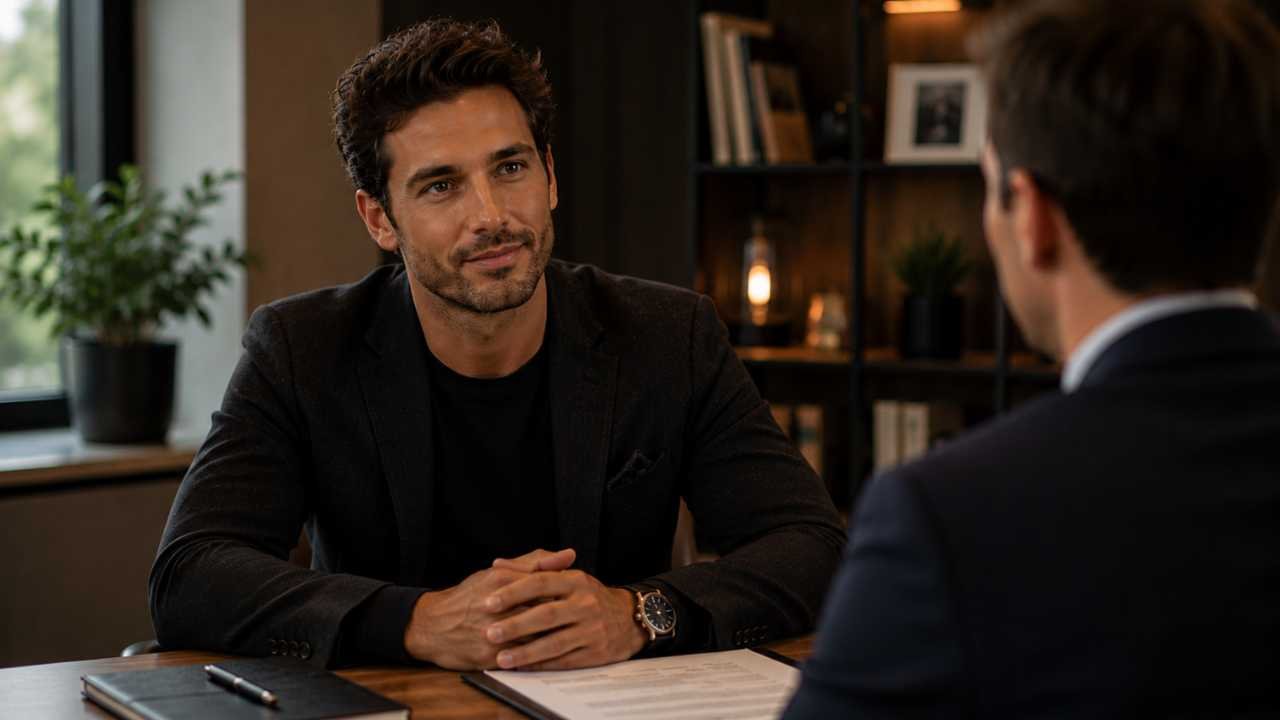
A job interview is not just about what you say. It is about how you are perceived before you even speak. Within seconds, the interviewer forms an impression based on your posture, your eye contact, your movement, and your overall presence. This happens automatically and often unconsciously.
Most people prepare answers. Very few prepare their body language. This creates a mismatch. The words may sound confident, but the body communicates hesitation, tension, or uncertainty. When that happens, people tend to trust the nonverbal signal more than the verbal one.
In performance environments, this is something you learn very quickly. You cannot fake presence under pressure. Your body reveals your internal state. The same principle applies in interviews. If your system is unstable, your body language reflects it. If your system is grounded, your body supports your message naturally.
This is where the difference between surface-level tips and real control becomes clear. You do not need to perform confidence. You need to build the conditions that allow it to appear.
What Is Body Language in Job Interviews?
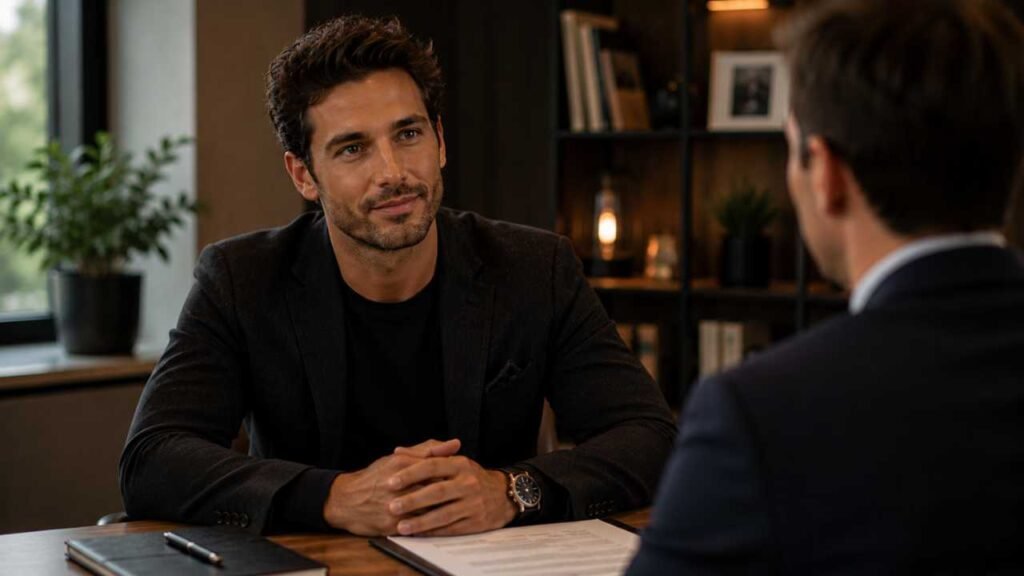
Body language in job interviews is the nonverbal communication you express through posture, facial expressions, eye behavior, movement, and spatial awareness during the interaction.
It functions as a parallel communication channel. While you speak, your body provides additional information about your emotional state, your level of confidence, and your ability to handle pressure. Interviewers use these signals to evaluate not only what you say, but how you operate as a person.
From a behavioral perspective, body language is an output of your internal system. Your nervous system, your beliefs, and your level of preparation all influence how your body behaves. This is why two candidates can give the same answer but be perceived completely differently.
Key Body Language Signals in Interviews
There are specific patterns that consistently influence how you are perceived in an interview setting.
1. Posture and Alignment
Your posture is one of the strongest signals. An upright, relaxed posture communicates stability and readiness, while a collapsed posture often signals insecurity or fatigue.
- shoulders relaxed, not pulled back rigidly
- spine naturally aligned
- body facing the interviewer
2. Eye Contact
Eye contact communicates attention and confidence. Avoiding eye contact can signal discomfort, while overly intense staring can feel unnatural.
- maintain consistent but natural eye contact
- look away briefly to avoid tension
- re-engage smoothly
3. Hand and Arm Position
Hands can either support your communication or create distraction.
- open hands signal transparency
- controlled gestures support clarity
- crossed arms often signal defensiveness
4. Movement and Stillness
Excessive movement often reflects internal instability.
- avoid constant shifting or fidgeting
- use stillness intentionally
- move when it supports your message
5. Facial Expression
Your face reflects your emotional state.
- neutral, engaged expression
- slight natural responsiveness
- avoid forced smiling
6. Breathing
Breathing affects everything else.
- slow, controlled breathing stabilizes your body
- fast breathing increases visible tension
Why Body Language Happens Under Pressure
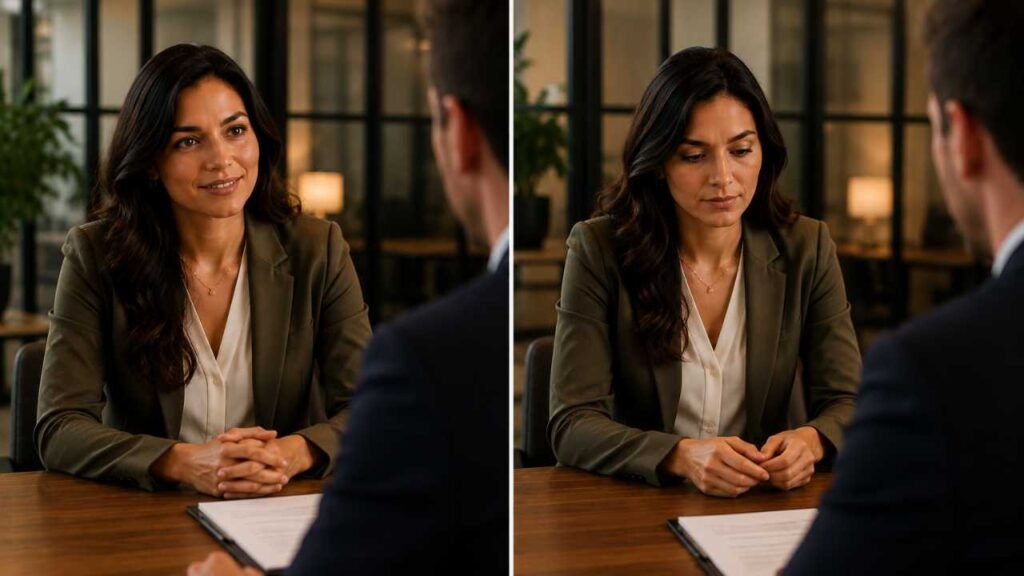
In an interview, your body is under evaluation. This activates your nervous system. The brain interprets the situation as a form of social risk. This can trigger protective responses.
These responses often include:
- increased muscle tension
- reduced movement or overcompensation
- shallow breathing
- avoidance behaviors
These reactions are not personal weaknesses. They are adaptive mechanisms. However, in a modern interview setting, they can create signals that are interpreted negatively.
This is why trying to control body language directly often fails. You are attempting to override a system response without addressing the cause.
Why Body Language Matters in Interviews
Body language influences hiring decisions more than most candidates realize. Interviewers are not only evaluating skills. They are assessing trust, reliability, and how you will function within a team.
Your body language affects:
- perceived confidence
- trustworthiness
- leadership potential
- communication ability
- emotional stability
There is also a consistency check. If your words say one thing and your body signals something else, the inconsistency creates doubt. In many cases, the nonverbal signal wins.
This is especially important in high-responsibility roles. Employers look for candidates who can remain stable under pressure. Your body language becomes evidence of that stability.
Can You Change Your Body Language for Interviews?
Yes, but not by forcing behaviors. Surface-level advice focuses on “correct posture” or “strong eye contact.” This creates tension and often makes the problem worse.
Body language is a system-level output. This aligns with a core principle of The FAVIE® System: stability before strategy. You do not fix your presence by controlling individual gestures. You improve your system so that your body behaves differently under pressure.
In many cases, once your internal regulation improves, your external behavior changes automatically. This is why authentic confidence feels effortless.
How to Improve Your Body Language Before and During an Interview
Improvement requires preparation that goes beyond answers.
1. Regulate Your Breathing
Your breathing is your fastest access point to stability.
- inhale through the nose
- extend the exhale slightly
- avoid shallow chest breathing
2. Ground Your Body
Stability starts from the ground.
- feet placed firmly on the floor
- weight evenly distributed
- avoid shifting constantly
3. Practice Stillness
Stillness communicates control.
- allow pauses
- avoid unnecessary movement
- let gestures be intentional
4. Rehearse Under Pressure
Practice changes behavior only when it includes pressure.
- simulate interview conditions
- record yourself
- review body language patterns
5. Align Internal State
Your body follows your internal condition.
- clarify your preparation
- reduce uncertainty
- build familiarity with your answers

Structure Creates Stability
A lack of structure increases internal pressure. When your preparation is unclear, your nervous system becomes reactive. This often shows up through tension, fidgeting, and inconsistent presence.
Structure reduces uncertainty. When you know what to expect and how to respond, your body stabilizes. This is why preparation is not just intellectual. It is physiological.
A structured planning system can support this by organizing your preparation process and reducing mental overload.
Structure Creates Stability
A structured planner from the FAVIE Shop can support interview preparation by creating clarity, repetition, and stability in your daily routine.
System-Level Perspective
Body language in interviews is not a separate skill. It is a reflection of your overall system.
The FAVIE® System emphasizes:
- stability before strategy
- discipline creates freedom
- emotional regulation is power
If your system is unstable, your body language will reveal it. If your system is structured and regulated, your presence becomes clear and consistent.
This is why long-term improvement comes from working on the system, not just the behavior.

Key Takeaways
- Body language strongly influences interview perception
- It reflects your internal state, not just conscious behavior
- Surface-level tricks do not create lasting change
- Stability and preparation are essential
- Awareness is the foundation of improvement
FAQ
What is the most important body language in a job interview?
Posture and eye contact are among the most important, as they directly influence perceived confidence and trust.
What body language should be avoided in interviews?
Avoid closed posture, excessive movement, lack of eye contact, and visible tension.
Can body language affect hiring decisions?
Yes, body language often influences how your competence and reliability are perceived.
How can I appear more confident in an interview?
Regulating your breathing and stabilizing your posture can help create immediate visible changes.
Is it possible to control nervous body language?
It can be improved, but long-term change comes from regulating your internal state rather than forcing behavior.
Final Thoughts
Body language in job interviews is not something you perform. It is something you reveal. The more stable and structured your internal system is, the more naturally your body will communicate confidence and trust.
When you shift your focus from controlling gestures to building stability, your presence changes in a way that feels real. This is what interviewers respond to.
If you want to go deeper, you can explore my training inside FAVIE Academy, where I teach how to build presence, confidence, and communication through structured, system-based methods.
Related FAVIE Academy Programs
⫸ FAVIE Academy Body Language
⫸ FAVIE Academy Confidence Training
⫸ FAVIE Academy Method
⫸ FAVIE How to Walk in Heels
⫸ FAVIE Posture Crash Course